

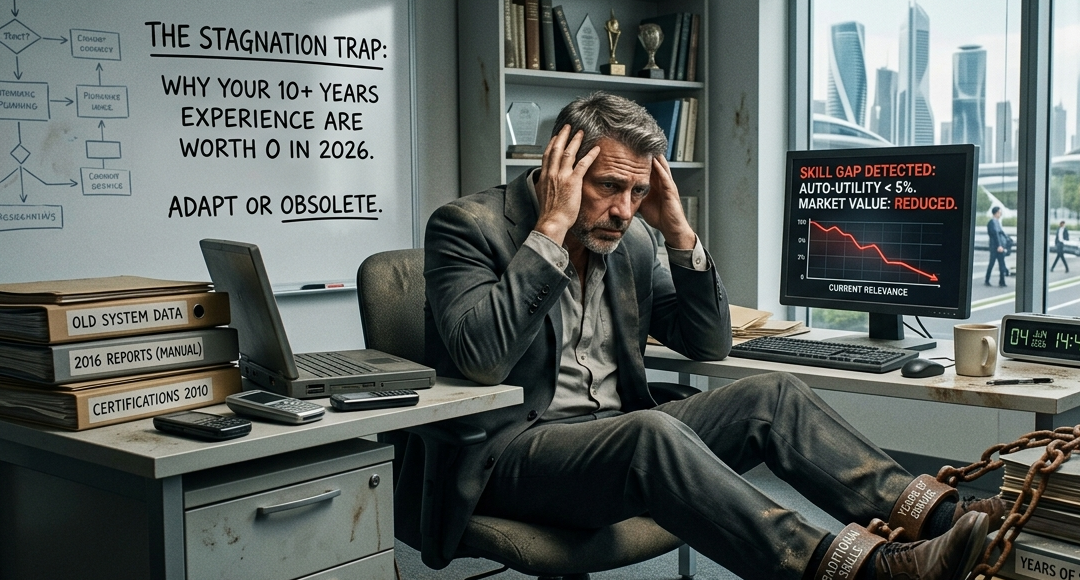
We were raised on a fundamental lie. The lie was simple: go to school, get a degree, land a stable job, and climb the corporate ladder. We were told that every year of service we dedicated to a company was equity in our future. We believed that ten years of experience meant something. It meant we were experts. It meant we were secure. It meant we were valuable.
But in 2026, that reality has imploded. The harsh truth that many professionals are now facing is brutal: your ten years of experience are probably worth nothing. In fact, that decade of dedication might actually be your single biggest liability.
The world did not just change while you were working; it reconfigured itself. The metrics that define value in the modern economy have been completely rewritten, and the old guard is being left behind, clinging to antiquated certifications and obsolete methodologies.
The Obsolescence of Longevity
The primary metrics of the old economy were longevity and loyalty. Companies valued employees who stayed for a decade because it meant stability. They compensated you for your « time served » rather than the raw value you created. In 2026, longevity is a signal of stagnation. Employers, partners, and investors do not care how long you have been doing something. They care about how effectively you can solve the problem right now.
A professional with two years of experience who has adapted to current market demands, learned new technologies, and mastered automated processes is infinitely more valuable than a professional with ten years of experience who is still operating based on the principles of 2016. The latter is not an expert; they are a relic. They are an overhead cost that companies are increasingly unwilling to pay.
Experience vs. Adaptation
What many people call « ten years of experience » is, in reality, one year of experience repeated ten times over. They stopped learning, stopped adapting, and stopped questioning the status quo the moment they felt comfortable. They relied on their seniority to protect them.
In 2026, there is no protection in seniority. If your « experience » did not include re-educating yourself every single year, then you have not been accumulating value. You have just been accumulating age. The moment your industry shifted—whether through automation, new market demographics, or technological disruption—your decades of expertise evaporated. Real experience is not measured in years; it is measured in your ability to pivot and your demonstrated results in modern contexts.
The Skills Void
Think about the core skills that defined your value a decade ago. Are those same skills still relevant today? If you are an accountant, are you still relying on manual entry rather than automated AI auditing systems? If you are a manager, are you still tracking attendance rather than leveraging decentralized workflow metrics?
If you cannot instantly identify how your process has fundamentally changed in the last three years, you have a skills void. And that void is not just a gap; it is a canyon that is swallowing your value. While you were relying on your « deep expertise » in an old system, a new generation of creators, entrepreneurs, and thinkers was mastering the new one from scratch, unburdened by the mental rigidness that comes from « the way we’ve always done it. »
Fighting the Stagnation
Acknowledging that your decades of service are now irrelevant is a painful process. It is a blow to the ego. It is a fundamental disruption to your identity. However, this acknowledgment is the only path forward. To survive 2026 and beyond, you must adopt a mentality of perpetual irrelevance. You must operate as though everything you know is obsolete every twelve months.
You do not need a new ten-year plan. You need a three-month plan to learn the current tools, understand the current market, and demonstrate results in the current ecosystem. You need to leverage your accumulated discipline and work ethic—the real value from those ten years—and apply it to the new reality. Your previous experience is a foundation, but it is no longer the structure.
Conclusion: Destroy the Ego
The « Stagnation Trap » is built on the ego of those who believe they are entitled to security based on their history. The market in 2026 is cold. It does not remember your loyalty. It does not celebrate your past achievements. It is ruthless in its valuation of current, relevant, and automated utility.
If you are currently comfortable because you « know your job, » you are the biggest target. Start questioning everything you know. Start mastering the systems that are designed to replace you. Destroy your own ego and rebuild your professional identity on a foundation of continuous adaptation, or accept that your years of service were simply payment for a future that has already expired. The choice is yours, but time is up.